
How to Plan a Fashion Collection from Moodboard to Line Plan
Plan a fashion collection step by step: build the moodboard, choose colorways and materials, structure a line plan table and gather feedback.
What is the first step in planning a fashion collection?
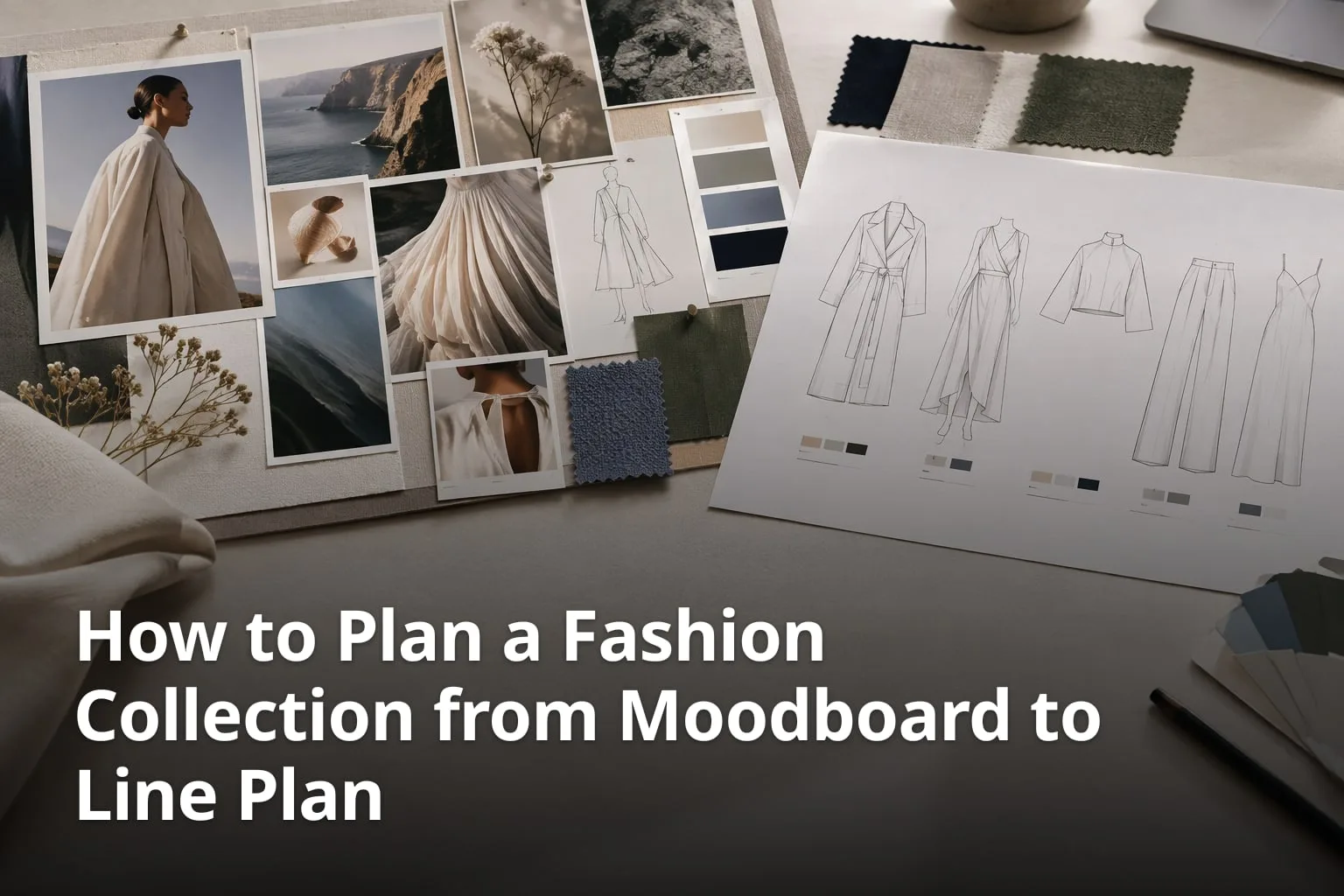
The first step is a moodboard: a collection of images, textures and notes that points the whole collection in one direction. Apparel Entrepreneurship describes the mood board phase as starting with research, and it asks you to decide up front what the board is for: a loose inspiration board that sets the vibe, or a final board with approved details. Everything after it, from colorways to the line plan, is easier to decide when that direction is written down and visible.
What are the key details to consider?
- Collect images, sketches, swatches and notes that point in the direction you want, and collect more than you need at first.
- Keep everything on one board so you can see the references side by side. Enterall boards hold references, sketches, color palettes and notes together.
- Settle on one theme or story for the collection and cut what pulls the board elsewhere.
- Add a short note next to each reference saying why it is there.
- Show the board to someone else early, and rework it if they miss the direction.
How do you create a fashion moodboard?
A fashion moodboard is built in four moves: research, collect, arrange and edit. The aim is a board where a teammate can see the idea at a glance and name the direction without a long explanation.
1. Gather visual references
Start with research. Apparel Entrepreneurship suggests going to galleries, museums, fabric fairs and shops, and looking at what is in style on the streets, at architecture and at design objects. Collect images, sketches, swatches and textures, and keep more than you will end up using. A wide pool makes it easier to see which references keep coming back.
2. Organize your references on a board
Put the references on one board so you can compare them side by side. In Enterall you can add images, text and links to a board, move and resize them, and group related items into clusters. Group by theme, color or garment detail, and make the strongest images the largest so the lead idea reads first.
3. Define the theme
Choose one direction for the season or collection and give it a short working title. A title gives the team a shared name to use in comments, in the line plan and later in presentations. Add a line of text beside each reference explaining what it contributes: a silhouette, a texture, a color mood or a finish.
4. Refine and test the board
Remove anything that pulls away from the theme, since a consistent board is the goal. Then show it to someone who has not seen it. If they miss the direction, rework the board before you move on to colors and materials. When it is ready, make a clean version to share with the people who will use it, such as a product developer, a photographer or a manufacturer.
Tip: save a clean copy of the board before you start cutting. Enterall keeps earlier board versions, so you can return to an earlier state if an edit takes the board somewhere you do not want.
How do you choose colorways and materials for your collection?
You choose colorways and materials by checking every option against the moodboard, then recording what you decided in one place. A colorway is a color treatment applied to a style, and the fabric choice affects the look, feel, price and quality of the garment, so both decisions deserve to be made with the references in front of you.
What are the key details to consider?
- Start from the moodboard and pick the colors and materials that carry its theme.
- Place swatches and material samples beside the references so you can judge how they work together.
- Decide which colorways each style will have, and keep the number manageable.
- Think about the fabric early: Points of Measure notes that it affects the look, feel, price and quality of the garments.
- Write the choices down next to the styles they belong to, so nobody has to ask which version was approved.
How do you select the right colorways and materials?
Work from the board outward: read the colors and materials already present in the references, narrow them to a short list, and compare the list visually before anything is final.
1. Read the colors and materials in your moodboard
Look at which colors and surfaces appear again and again in your references. Those repeats are usually your strongest candidates. Extract or place color swatches on the board so the palette is visible as its own cluster rather than something people have to infer from the photos.
2. Compare options side by side
Place the candidate colorways and material samples next to the key references. Seeing them together shows quickly which ones belong to the story and which ones fight with it. If you want to try a colorway or a material change on a sketch or product photo, Enterall's AI tools can test colorways and swap materials on an image you upload.
3. Review what the AI shows you
AI results are a starting point. Small details in construction, trims, text and materials can change in a generated image, so check seams, trims and proportions against your reference before you treat an image as an agreed direction. Treat the result as visual direction, not as a production specification.
4. Think about how the fabric will be used
Consider what each material has to do in the garment and how it fits the season you are planning for. Ask your supplier about the fabric rather than deciding on appearance alone, and note the answer next to the style it belongs to.
5. Record the decision
Write down the chosen colorways and materials where the whole team can find them. A short note on the board works for a first pass; the line plan table in the next section is where they become structured data for each style.
How can you create a cohesive line plan?
A cohesive line plan is a table with one row per style that lists the details of each garment in the collection. Points of Measure describes a line plan as the process of mapping out the range of styles a fashion brand will offer, and says it should keep all garments in the collection cohesive in terms of design, color and fabric.
What goes into a line plan?
Points of Measure lists eight components of a line plan, and they make a good checklist for your own columns.
- Technical sketch: a quick visual cue for the garment's design and silhouette.
- Style and design details: the specific garments in the collection.
- Colorways: the colors available for each style.
- Size range: the sizes estimated for each garment.
- Fabric selection: the fabric chosen for each style.
- Cost per garment: the estimated cost of producing it.
- Target retail price: the price at which the garment will be sold.
- Order quantities: the number of units to produce for each style.
How do you build the line plan step by step?
Build the line plan in four passes: create a template, detail each style, review, and finalize. These steps follow the process described by Points of Measure.
1. Create a template
Decide the format before you fill anything in. List the columns you need, for example style name, sketch, colorways, fabric, sizes, cost, target price and order quantity, and keep the same columns for every style. In Enterall, a table can have typed columns, so a price column holds numbers and a colorway column holds the text you choose, and you can sort and filter the rows.
2. Detail each style
Choose which garments belong in the collection, then fill in the design, color, size and fabric details for each style and estimate costs and retail prices. Fashion Brain Academy suggests 3 to 8 styles for a first womenswear collection, and notes that 9 pieces could be just 3 styles in 3 different colors. TEG says its own advice for a first collection is at least ten pieces or so, so the right size depends on your market, your manufacturer and your sales channels.
3. Check each row against the moodboard
Open the board next to the table and ask of each row whether it belongs to the same story. Look for repeats and gaps: two styles that do almost the same job, or a colorway that appears in the plan but not on the board. Points of Measure puts the goal as keeping the collection cohesive in design, color and fabric.
4. Review, adjust and finalize
Share the plan, collect feedback, adjust, and finalize it once all details are settled. Points of Measure says the finalized plan then serves as the reference for the collection's development, so keep a record of what changed between versions.
Tip: add a column for open questions. A visible list of what is still undecided keeps the plan honest while it is still changing.
How do minimum order quantities affect the plan?
The order quantity column is where the plan meets the factory. TEG defines minimum order quantities, or MOQs, as the minimum number of items in a clothing order that a manufacturer will accept, and notes that MOQs of 50 or more can prove to be a tall order for new designers. Ask each manufacturer for its MOQ before you finalize quantities, and record it in the plan so a style is not scheduled in a size run nobody will produce.
How can you use comments to collaborate effectively?
Comments work best when each one is attached to the exact thing it is about, so the person reading it can see what is meant without a separate message. In Enterall, comments attach to the relevant material on the board, and mentions notify the person you name.
1. Comment on the item, not next to it
Put the comment on the image, swatch or row it concerns. A comment on a specific colorway is easier to act on than a general message about colors, because the reader sees the exact item in view.
2. Mention the person who needs to answer
Use a mention when a question is for one person, such as the pattern maker or the person handling production. It tells them they are expected to respond, and it keeps everyone else from guessing who owns the answer.
3. Say what you want to happen
A useful comment states the issue and the proposed change: this blue reads too cold next to the linen references; try the warmer option. Short, specific comments are quicker to answer than long opinions.
4. Close the loop in the table
When a comment leads to a decision, record that decision in the line plan or in a note on the board. That way the conclusion does not stay buried in a thread and the plan always shows the latest choice.
Note: keep comments short and respectful. A board with a clear, focused thread is easier for a client or colleague to review than one crowded with side remarks.
Why is it important to keep all references and plans in one workspace?
Keeping references and plans together means the reasoning behind a decision stays next to the decision. When the moodboard sits in one place and the line plan in another, someone has to rebuild the connection by hand every time a question comes up, such as why a certain fabric was chosen or which reference a colorway came from. Enterall is built around keeping that context together: it describes its boards as a place where references, decisions, written context and plans stay connected, instead of being scattered across inspiration folders, message threads, documents and spreadsheets.
1. Start with one board per collection
Give each collection its own board and put the moodboard, the color palette, the material samples and the sketches on it. A single address for the collection means new teammates know where to start.
2. Put the line plan next to the references
Create the line plan table on the same board or connected to it, so each row sits near the images that inspired the style. In Enterall, tables and documents can be created alongside board material.
3. Let people in at the right level
Invite the people who need to see or edit the work. According to Enterall's site, you can invite collaborators to work together in real time or enable a share link for a board, and the share link can be set to view or edit. Choose the lowest level of access that lets each person do their part.
4. Update the source, not a copy
When something changes, change it on the board or in the table rather than in an exported copy. Exports go out of date; the board is the one place that people look. Enterall also keeps earlier board versions, which helps if you need to see what the plan looked like before a change.
What does one shared place change in practice?
- References, colorway decisions and the line plan can be read together instead of in separate files.
- Comments stay attached to the item they are about.
- Teammates and clients open the same board, so everyone is reading the same version.
- Earlier board states can be reviewed, which makes changes easier to trace.
How do you refine your collection during the planning process?
You refine a collection by repeating a short loop: look at the moodboard and the line plan together, compare alternatives, take feedback, adjust, and write the change down. Planning is rarely finished in one pass, and the loop keeps changes deliberate rather than accidental.
1. Review the moodboard and line plan together
Open both and read them as one story. Do the styles in the table look like they belong on the board? Check the colors, materials and silhouettes for consistency, and ask whether any style could be removed without weakening the collection.
2. Compare alternatives side by side
If you are torn between two colorways or two materials, put them next to each other on the board. In Enterall you can build visual comparisons and place generated or edited images beside the original, which makes the differences easier to see than they are in a list.
3. Bring in feedback
Share the board and the plan with the people whose view you need and let them comment on specific items. Ask for reactions to the direction first and to details second.
4. Adjust designs, materials or colorways
Make the changes the feedback calls for, and then recheck the line plan for gaps, such as a color with no matching style, or overlaps, such as two near-identical styles.
5. Document the change
Update the table and the board together, and note briefly why you changed something. A one-line reason saves a repeat discussion a month later.
What are the key details to consider?
- Review the moodboard and the line plan together, not separately.
- Compare options side by side on the board.
- Collect feedback through comments on the specific items.
- Adjust designs, materials or colorways, then recheck the table.
- Record each change and the reason for it.
What role does feedback play in planning a fashion collection?
Feedback is how a collection plan gets tested before money is committed. Points of Measure says a line plan is reviewed and adjusted based on feedback from the development team and management, and Apparel Entrepreneurship recommends testing a mood board on someone else and reworking it if they miss the direction. Both point to the same habit: let other people react early, while changes are still cheap.
1. Share the board early
Invite collaborators to view and comment on the moodboard and the first concepts, before the line plan is detailed. Early feedback is the easiest to act on. In Enterall, the access you give controls who can view or edit the board.
2. Ask about specific things
Ask people to comment on particular images, swatches or rows. A request such as please look at the three outerwear styles gives you better answers than please have a look at everything.
3. Bring the feedback into the plan
Take the comments that you accept and turn them into changes to the table and the board: a different colorway, a missing reference, a style removed. Note the ones you decide not to follow, with a reason.
4. Ask different roles
Design, production and marketing each read a line plan differently. Points of Measure notes that a line plan keeps design, production and marketing on the same page, so it makes sense to ask each of them for a view.
5. Keep a record
Keep the feedback and the resulting changes where the team can find them. A short log of what changed and why makes it easy to explain the plan to a new colleague or a client.
How can Enterall support your fashion collection planning?
Enterall is a visual workspace for fashion and apparel teams, and it covers the steps in this guide with boards, AI image tools, tables and comments. According to its site, it is free to start, with no credit card needed.
1. Create a board for your moodboard
Bring references, sketches, color palettes and notes together on one board. You can also paste links and add text, and import material from public Pinterest boards.
2. Explore colors and materials
Use Enterall's AI tools to turn a sketch into a rendered concept, test colorways, swap materials or refine a detail on an existing image. Review each result for details that may have changed.
3. Structure the line plan in a table
Use a table with typed columns for the styles in your collection, and use sorting and filtering to look for gaps and overlaps.
4. Collaborate through comments and sharing
Invite collaborators or enable a share link, and let people comment on the board. Mentions notify the person you name.
5. Present the direction
When the direction is agreed, turn selected board material into a presentation, or write a brief or production note in a document connected to the board. Features change over time, so check the product for what is available today.
What is a moodboard and why is it important?
A moodboard is a collection of images, textures, swatches and notes that sets the direction for a collection. It gives the team one visual reference to check every later decision against, from colorways to materials to the line plan.
How do you ensure your line plan is complete?
Compare it against the eight components Points of Measure lists: technical sketch, style and design details, colorways, size range, fabric selection, cost per garment, target retail price and order quantities. Then check each style against the moodboard for cohesion in design, color and fabric.
Can Enterall help with team collaboration?
Yes. Enterall lets you invite collaborators to work together in real time or enable a share link that can be set to view or edit, and people can comment on items on the board.
What should be included in a fashion collection line plan?
A line plan should list, for each style, a sketch, the design details, colorways, size range, fabric, cost per garment, target retail price and order quantity. Add your own columns, such as open questions, where your process needs them.
How does Enterall keep the creative process organized?
References, AI image tools, tables and comments sit on one Enterall board, so the moodboard, the colorway decisions and the line plan can sit together and be reviewed in one place.
What are the benefits of using structured tables in Enterall?
Tables with typed columns hold numbers, text and other values in the form that suits each column, and sorting and filtering help you review a line plan for gaps and overlaps.
Written by Alex, CTO at Enterall.
What are the sources?
Which sources does this guide use?
- Apparel Entrepreneurship, https://www.apparelentrepreneurship.com/how-to-create-a-fashion-mood-board/
- Points of Measure, https://www.pointsofmeasure.com/tutorials-education/line-plans-for-fashion-design
- Fashion Brain Academy, https://fashionbrainacademy.com/how-many-styles-should-be-on-your-clothing-line/
- TEG, https://tegmade.com/resources/how-many-pieces-are-in-a-fashion-collection/
- Enterall, https://enterall.co