
Enterall vs Higgsfield: Fashion Design Board or AI Media Suite?
Enterall is a board-based workspace for fashion and apparel designers; Higgsfield is a broad AI image, video and voice suite. Here is how they compare on collaboration, AI tools, workflow and pricing.
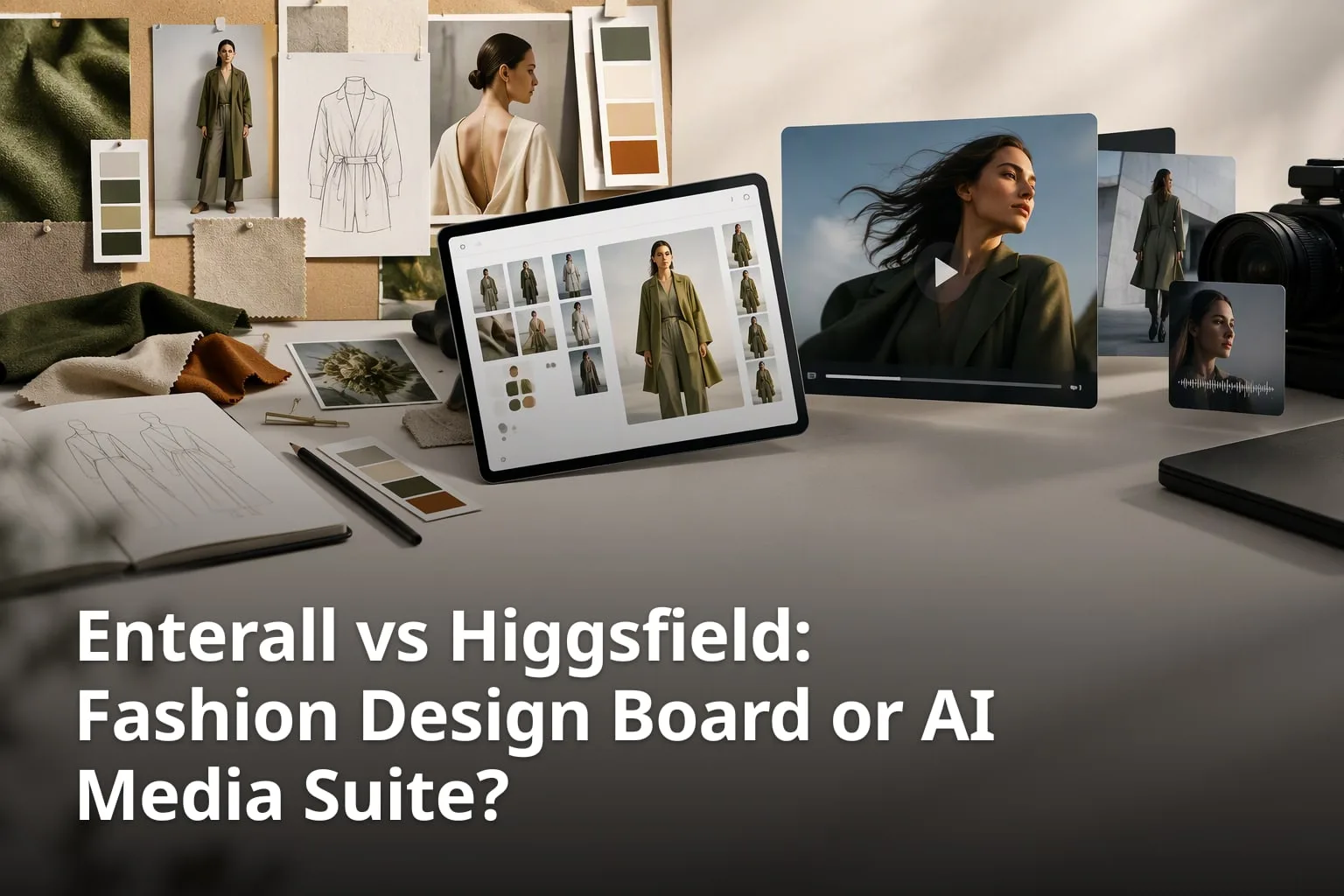
Enterall and Higgsfield both use AI to turn ideas into images, but they are built for different jobs. Enterall calls itself "the visual workspace for apparel and fashion teams": a board where references, sketches, colour palettes and notes sit next to AI image tools. Higgsfield calls itself an AI-native creative suite that lets you "create images, videos, and voice content" from text prompts or references, with editing, upscaling and an AI agent. This comparison sets out what each company says its product does, based on their own websites as checked in October 2026, so you can match the tool to the work in front of you rather than to a ranking.
What is Enterall built for?
Enterall is a board-based visual workspace for fashion and apparel designers, from independent creatives to teams, with AI image tools built into the board.
Its own FAQ puts it this way: "Bring references, sketches, colour palettes and notes together on a board, then develop and visualize your ideas with AI image tools." You can upload sketches, product photos and reference images and use them as the starting point for new work. The about page describes the product more broadly as "a collaborative visual board for organizing ideas, images, and workflows", so the board is meant to hold the thinking behind a design as well as the images that come out of it.
The home page lays out the path Enterall is designed around in six steps: bring a sketch to life, change colour and material, refine the length and details, create a tech pack, see it on a model, and create the packshot. The headline sums it up as "From sketch to tech pack", with "Colourways, scenes and fits, without a sample round." For a designer, that means a garment can move from a rough drawing to rendered options and a product-style image without leaving the board where the references live.
Boards are not the only container. Enterall's terms cover "workspaces, boards, documents, AI tools, and MCP connections", and its connector page says you can "create private boards and documents, organize references, and develop images" from ChatGPT, Codex or Claude. No AI experience is needed: the FAQ says you can start in your browser, add a reference or sketch and describe the change you want in plain language, "such as trying a new colour or changing a fabric."
Collaboration is built into the board. Enterall says you can "Invite collaborators to work together in real time, or enable a share link for your board," and that sharing settings let you choose whether people with the link can view or edit it. You can also download images from a board to use in the rest of your design workflow.
| Feature | Enterall | Higgsfield |
|---|---|---|
| What it is | Visual workspace for apparel and fashion teams | AI-native creative suite for images, video and voice |
| Workspace | Boards with references, sketches, colour palettes, notes and documents | Canvas, a node-based infinite board, plus shared team folders |
| AI tools | Rendered concepts from sketches, colourways, materials, outfits, on-model and packshot-style images, image editing | Many image and video models, Edit Image, Inpaint, Upscale, Cinema Studio |
| Fashion and product work | Sketch to tech pack, see it on a model, create the packshot | Virtual try-on, Fashion Factory, Marketing Studio product shots |
| Collaboration | Real-time collaboration, share links with view or edit access | Real-time Canvas collaboration; team plan with roles, comments and approvals |
| Pricing model | Credits: free start, Starter and Pro monthly plans, custom Enterprise | Credits from a plan balance; Team and Enterprise plans |
| Use from AI assistants | MCP connection for ChatGPT, Codex and Claude | MCP for Claude and a ChatGPT plugin |
What are the key details to consider?
- Stated audience: fashion and apparel designers, from independent creatives to teams.
- Boards hold references, sketches, product photos, colour palettes and notes.
- AI tools turn sketches into rendered concepts, explore colourways, change materials, combine references and build outfits.
- An existing image can be edited to develop a specific detail or try another direction.
- Collaborators can work in real time, and share links can be set to view or edit.
- The account is free to start with no credit card; Starter and Pro plans add monthly credits.
What is Higgsfield built for?
Higgsfield is an AI image, video and voice generation suite aimed at creators, marketing agencies and filmmakers, with editing tools, a node-based Canvas and a team workspace.
Higgsfield's site description reads: "Create images, videos, and voice content with Higgsfield AI from text prompts or references. Edit and upscale media, automate creative workflows with its AI agent, and generate content on web and mobile." Its about page says it gives "creators, marketing agencies, and filmmakers the power to produce cinematic-quality video and visuals at any scale." Higgsfield's home-page description lists more than 30 models, including Sora 2, Kling 3.0 and Veo 3.1, along with face swap, virtual try-on and a cinema studio.
The site menu shows how wide the toolset is. Under editing it lists Edit Image, Inpaint and Upscale. Under studios it lists Cinema Studio, Marketing Studio, Lipsync Studio, Fashion Factory and Higgsfield Canvas. Marketing Studio is pitched as a way to "Turn any product into ready to post content", with templates for product shots, motion, UGC, ads and posters, and Ads Studio's Ad Multiplier lets you "Recreate ad with your products, characters". There is also an agent called Supercomputer, described as "One superagent for your entire creative stack".
For organizing work, the key tool is Canvas. Higgsfield's help center says: "Canvas is Higgsfield's node-based infinite board for multi-model visual production," where "a prompt feeds an image, the image feeds a video, the video feeds an edit." Every Higgsfield model is available as a node, and Canvas can run models in parallel, compare outputs side by side and save a whole workflow as a reusable template. Building and connecting nodes is free; credits are deducted only when a node generates content.
What are the key details to consider?
- Positioning: an AI-native creative suite for images, video and voice.
- Audience named on its about page: creators, marketing agencies and filmmakers.
- Editing tools listed on the site include Edit Image, Inpaint and Upscale.
- Canvas chains models on a node-based board and can compare outputs side by side.
- Marketing Studio and Ads Studio are aimed at product content and ads.
- Team and Enterprise plans add shared workspaces, roles and permissions.
How do Enterall and Higgsfield handle collaboration?
Both support real-time collaboration. Enterall does it on a shared board with share links set to view or edit; Higgsfield does it on shared Canvas boards and in a team workspace with roles, comments and approvals.
In Enterall, you invite collaborators to work on a board together in real time, or turn on a share link and decide whether people with the link can view or edit. The privacy policy lists board content as "titles, notes, shapes, comments, and images you upload or generate", so comments live on the board with the work. The terms add a sensible warning: "Content made available to collaborators, public viewers, or connected applications may be received or copied by those recipients." In practice, give edit access to the people shaping the design and view access to everyone else.
Higgsfield documents collaboration in two places. On Canvas, its help center says: "Multiple team members can work on the same canvas simultaneously: each can add nodes, connect references, and trigger generations independently, and outputs appear on the shared board in real time." Its team plan page adds personal or shared folders with "searchable, versioned assets", user roles and access permissions managed from an admin dashboard, chat and comments inside projects, and built-in video calls. The team FAQ says you can "assign roles, leave comments, track approvals, and manage multiple projects simultaneously".
Which model suits you depends on the size and shape of the team. If feedback happens around one design board, with references, palettes and notes in view, Enterall's board and share-link approach keeps it simple. If you need formal roles, approval tracking and a folder structure for large numbers of generated assets, Higgsfield's team page documents more of that. Enterall's public site does not describe roles or approval tracking.
What are the key details to consider?
- Enterall: invite collaborators to work on a board in real time.
- Enterall: share links can be set to view or edit.
- Enterall: comments are part of board content, according to its privacy policy.
- Higgsfield: several people can work on the same Canvas at the same time.
- Higgsfield: the team plan adds shared folders, roles, chat and comments.
- Higgsfield: its team FAQ mentions tracking approvals.
How do Enterall and Higgsfield handle AI image generation?
Enterall's AI tools are scoped to fashion design steps on a board, while Higgsfield offers a broad library of image and video models plus general-purpose editing tools.
Enterall's FAQ lists what its tools do: "Turn sketches into rendered concepts, explore colourways, change materials, combine references, build outfits and create packshot-style images. You can also edit an existing image to develop a specific detail or try another direction." Because generation happens on the board, each result sits next to the sketch, swatches and notes it came from. A typical pass follows the home-page steps: render a sketch, try a new colour or fabric, refine the length and details, then see the piece on a model and create a packshot.
Enterall is not limited to stills. Its pricing page estimates how many standard images, pro images and 8-second videos each plan's credits cover, at 720p, 1080p and 4K, with 4K not available on the free plan. On ownership, the FAQ says: "You retain your rights to the images you upload. Enterall does not claim ownership of your generated images. We don't use your images to train AI models, and our AI providers don't train on them by default."
Higgsfield takes a model-library approach. Its menu lists image models such as Nano Banana, Flux 2, Seedream 5, GPT Image 2 and Ideogram 4.5, video models such as Seedance, Kling, Veo and Sora, and a model called Soul, presented as "Ultra-Realistic Image Generations". Edit Image, Inpaint and Upscale handle changes after generation, and on Canvas you can run several models on the same prompt and compare the outputs side by side. Its platform description also lists virtual try-on.
What are the key details to consider?
- Enterall: sketch to rendered concept, colourways, materials, outfits and packshot-style images.
- Enterall: edit an existing image to develop a detail or try another direction.
- Enterall: its pricing page estimates outputs for images and 8-second videos.
- Higgsfield: many image and video models under one account.
- Higgsfield: Edit Image, Inpaint and Upscale tools.
- Higgsfield: side-by-side comparison of model outputs on Canvas.
How does each platform organize a project from start to finish?
Enterall organizes work around a design board that carries a garment from sketch to tech pack; Higgsfield organizes work as generation pipelines on Canvas and as assets in shared team folders.
In Enterall, the board is the project. A designer might upload a sketch and a few fabric references, add a colour palette and notes, ask for a rendered concept, try two colourways, refine the length, then create a tech pack, see the piece on a model and make a packshot, all on the same board. Documents sit alongside boards, and through the MCP connection an assistant such as Claude or ChatGPT can find your boards, read them and develop images on them. Enterall's setup guide suggests starting with "Find my Enterall boards." and selecting a board before asking for changes.
In Higgsfield, a project is more often a pipeline. On Canvas you add a text prompt node, connect it to a generation node, drag one node's output into the next and run nodes one at a time or in sequence, then save the whole chain as a template to reuse. Team plans store the results in personal or shared folders. For planning, Higgsfield offers Dots in ChatGPT, described as a way to "Plan and make a creative project step by step", and its Supercomputer agent. This suits work where the end product is a set of images or videos made through several model steps.
What are the key details to consider?
- Enterall: one board for references, sketches, palettes, notes and generated images.
- Enterall: documents alongside boards, according to its terms and MCP page.
- Enterall: a documented path from sketch to tech pack, model image and packshot.
- Higgsfield: Canvas pipelines where one node's output feeds the next.
- Higgsfield: workflows can be saved as reusable templates.
- Higgsfield: team folders with searchable, versioned assets.
Which kinds of work suit each platform?
Enterall names one audience, fashion and apparel designers; Higgsfield names creators, marketing agencies and filmmakers, and its team page lists marketing, design, sales and learning use cases.
Everything on Enterall's home page is about developing garments: colourways, materials, fits, scenes, tech packs, on-model images and packshots. It says it serves "independent creatives to teams", and its Enterprise page says pricing and credit allocation are custom for each team. If your creative ideas are clothes in development, that focus means less setup: the steps you need are already the ones the product is built around.
Higgsfield's scope is wider. Its about page names creators, marketing agencies and filmmakers. Its team page lists use cases for marketing, design, sales, and learning and development, and describes the marketing use case as "Generate and A/B test hundreds of high-performing ads in minutes", which is the company's own pitch, not an independent result. Cinema Studio and Lipsync Studio point to video production, which is outside Enterall's stated focus.
The two overlap on fashion product imagery. Enterall's model images and packshots are part of the design process on the board, while Higgsfield lists virtual try-on and a Fashion Factory studio next to Marketing Studio product-shot templates. A simple way to choose is to ask where the work starts. If it starts with a sketch you are still developing, Enterall's path from sketch to tech pack is built for it. If it starts with a finished product you need to turn into ads, posters or video, Higgsfield's marketing tools are built for that.
What are the key details to consider?
- Fashion and apparel design teams: Enterall's stated audience.
- Independent designers: Enterall says it serves independent creatives as well as teams.
- Marketing agencies and filmmakers: named on Higgsfield's about page.
- Product and ad content: Higgsfield's Marketing Studio and Ads Studio.
- Garment development up to a tech pack: Enterall's six-step path.
- Cinematic video and lip sync: Higgsfield's Cinema Studio and Lipsync Studio.
How easy is it to get started with each platform?
Enterall says no AI experience is needed and runs in the browser; Higgsfield works on web and mobile and gives you a much larger set of models and tools to choose from.
Enterall's FAQ says: "No AI experience is required, and you can get started in your browser." You create an account without a credit card, confirm your email and get free credits to try the tools on your own ideas. There is also a free custom-board offer: send links to your public content and inspiration and Enterall says you will "receive a customized board within 48 hours."
Higgsfield's breadth means more choices up front: which model, which studio, which preset. To help with that, its menu links to an Academy and a Community section, and its team FAQ says no technical expertise is needed and mentions guided onboarding. Both products also reach into AI assistants. Enterall connects to ChatGPT, Codex and Claude through MCP, and Higgsfield offers MCP for Claude ("Generate images and videos in Claude") and a ChatGPT plugin.
What are the key details to consider?
- Enterall: browser-based, with changes described in plain language.
- Enterall: free account without a credit card, with one-time free credits.
- Enterall: connects to ChatGPT, Codex and Claude through MCP.
- Higgsfield: generates content on web and mobile.
- Higgsfield: Academy and Community sections linked from the menu.
- Higgsfield: MCP for Claude and a ChatGPT plugin.
How do pricing and data handling compare?
Both charge for AI work in credits. Enterall publishes its plan prices, while Higgsfield's Enterprise tier is sized to each team's seats and generation volume.
Enterall's pricing page lists a Free plan with 200 credits, once, and no payment needed. Starter costs 150 DKK a month for 1,000 credits a month, and Pro costs 500 DKK a month for 6,000 credits a month. Enterprise is custom, with credits set for your team. Prices can also be shown in USD and EUR. Starter and Pro renew monthly, unused credits don't roll over, and how many credits a job uses depends on the tool and the output you choose.
Higgsfield's Enterprise page says it "uses credit-based pricing on annual contracts with monthly payments, sized to your team's seats and generation volume," and lists an unlimited number of seats. On Canvas, building and connecting nodes is free and credits come from your plan balance only when a node generates. On data, Higgsfield's team page describes the service as "SOC2 & ISO42001 aligned" and "GDPR compliant". Enterall states that it doesn't use your images to train AI models, and its legal page describes "baseline security controls appropriate for an early-stage SaaS product". If certifications matter to your organization, ask each vendor for the documents behind these statements before you upload client work.
What are the key details to consider?
- Enterall Free: 200 credits, once, no payment needed.
- Enterall Starter: 150 DKK a month for 1,000 credits a month.
- Enterall Pro: 500 DKK a month for 6,000 credits a month.
- Enterall: unused credits don't roll over.
- Higgsfield Canvas: building nodes is free; credits are used when a node generates.
- Higgsfield Enterprise: annual contracts sized to seats and generation volume.
Which platform should you choose?
Choose Enterall if your creative ideas are garments in development and you want one board for references, sketches, notes and AI-rendered options. Choose Higgsfield if you need a wide range of image and video models, product and ad content, or a team workspace with roles and approvals.
They are not direct substitutes. Enterall is narrow on purpose: its features follow a fashion designer from sketch to tech pack, on-model image and packshot. Higgsfield is broad: it covers still images, video, voice, lip sync, effects and marketing templates for many kinds of creators. Some teams may use both, developing a design on an Enterall board and then producing campaign video elsewhere. Neither company documents a direct integration with the other, so files move by download and upload.
Both offer a way to test before paying. Enterall's Free plan includes one-time credits with no credit card, and on Higgsfield's Canvas you can build a pipeline without spending credits until a node generates. A short trial with one real project, such as a single garment or a single product shot, will tell you more about fit than any feature list.
What is Enterall's primary focus?
According to its website, Enterall is a visual workspace for fashion and apparel designers. Boards combine references, sketches, colour palettes and notes with AI image tools for colourways, materials, on-model images and packshots.
How does Higgsfield differ from Enterall?
Higgsfield is a general AI creative suite for images, video and voice, with many models, editing tools, a node-based Canvas and marketing studios. Enterall is narrower: a design board for fashion and apparel work, from sketch to tech pack.
Which platform suits fashion teams?
Both have fashion-related tools. Enterall is built around garment development: rendering sketches, colourways, materials, tech packs, on-model images and packshots on one board. Higgsfield lists virtual try-on and a Fashion Factory studio, along with product-shot templates in Marketing Studio. The right choice depends on whether you are developing a design or producing content for a finished product.
Can Enterall and Higgsfield be used together?
Neither company documents a direct integration. Enterall lets you download images from a board for use in your wider design workflow, and Higgsfield Canvas accepts uploaded reference images, so you can move files between them by hand.
Does Enterall support external client collaboration?
You can enable a share link for a board and choose whether people with the link can view or edit it, or invite collaborators to work in real time. Enterall's website does not describe a separate client-review or approval feature.
Is Higgsfield suitable for team-based workflows?
Yes, according to its site. Higgsfield's team plan offers shared folders, roles and access permissions, chat and comments inside projects, and approval tracking, and several people can work on the same Canvas in real time.